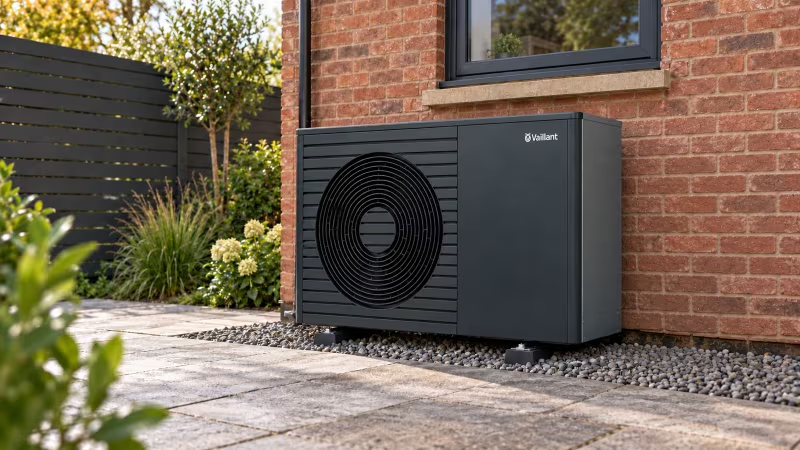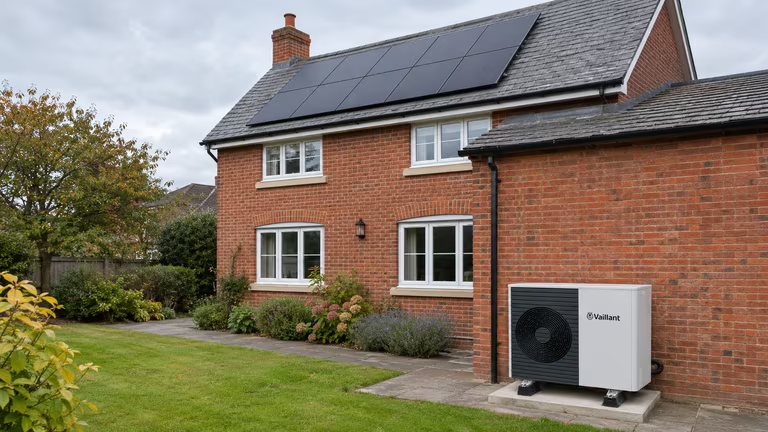
Can solar panels power a heat pump?
Yes. Solar photovoltaic (PV) panels generate electricity, and a heat pump uses electricity to move heat into your home. When generation and demand coincide, solar can supply part of that electrical demand. It does not mean the heat pump will run entirely on solar power: Energy Saving Trust’s heat-pump guide explains why grid electricity is still needed at times with little or no generation.
This guide considers electricity-generating solar PV alongside a conventional air-to-water heat pump supplying water-based heating and hot water in a grid-connected home. Solar thermal panels collect heat instead. A specialised solar-assisted heat pump, which uses an evaporator panel to collect heat for hot water, is also a different arrangement.
What changes between summer and winter?
The strongest solar generation and the greatest space-heating demand usually occur at different times of year. The Centre for Sustainable Energy describes this seasonal mismatch. A battery can move some daytime electricity into the evening; a normal home battery is not a way to save summer’s surplus for winter. That distinction remains even when annual generation looks similar to annual heat-pump electricity use.
| Situation | What the combined design should explain |
|---|---|
| Bright summer day | How much electricity remains after household use and hot water, and where any surplus goes. |
| Spring or autumn | How daytime generation overlaps with a smaller heating requirement. |
| Cold winter period | The expected grid imports when the home needs sustained heating and solar production is limited. |
| Evening or overnight | How heating and other appliances are supplied after solar generation stops. |
Compare the seasons rather than treating a sunny day as a year-round forecast.
What should be assessed together?
The heating design comes first in deciding how much heat each room needs. Ask for the room-by-room heat-loss assessment, proposed radiator or underfloor-heating changes, and intended flow temperature. Energy Saving Trust’s sizing guidance shows that a heat pump’s output and efficiency depend on operating conditions. Its quoted heat output is not the same figure as its electricity consumption.
The solar assessment needs its own evidence. Roof space, orientation and shading affect what can be generated, as Energy Saving Trust’s solar guidance explains. Ask for the actual proposed layout and its generation estimate. There is no universal number of panels that will “run a heat pump” in every home.
Use the same version of the house. If insulation or an extension is planned, confirm whether both designs assume that work has happened.
Include the other electrical demand. Cooking, household appliances and any electric vehicle still need to be accounted for alongside heating.
Separate measured data from assumptions. Bring existing solar records and energy bills if available; ask which missing information has been estimated.
Agree responsibility. Identify who will check the combined design and resolve problems involving more than one system.
Also ask who will handle the electricity-network requirements and check the existing supply. Government guidance for Great Britain lists heat pumps, solar PV and battery storage among the devices that must be registered with the local Distribution Network Operator. The installer should confirm the applicable process and any approvals required for the whole proposal.
Can the controls make better use of solar?
They can help, but comfort and a sound heating design remain central. Energy Saving Trust’s operating guidance discusses weather compensation, longer operating periods and suitable flow temperatures. Weather compensation adjusts the heating-water temperature in response to outdoor conditions. Ask your installer to explain the settings chosen for your home.
Discuss whether some hot-water heating can take place during likely solar production or a suitable tariff period. Any schedule must still provide the hot water you need and preserve the manufacturer’s hygiene and safety settings. Do not disable protective cycles or force all heating into a short sunny window to improve an app’s self-consumption figure.
If you already have a solar diverter, smart thermostat or battery controller, show the installer how it is configured. Ask which device sets each schedule and what happens when they request electricity at the same time. Agree a simple normal setting and whom to contact before changing more advanced controls.
Would a battery make the combination better?
A battery is optional. Energy Saving Trust’s storage guide describes using stored electricity for a heat pump and combining storage with a time-of-use tariff. Whether that is useful here depends on the energy available to charge it, the later demand and the proposed equipment. The battery’s power limit matters as well as how much energy it holds.
Request the solar-and-heat-pump proposal with and without storage. Ask what the battery is expected to do in winter: store solar, charge from the grid, or both. A model that assumes it is refilled by solar every day needs to explain how that happens during low-generation periods.
If power-cut cover matters, make it a separate design requirement and ask exactly which equipment and circuits would be supported. Do not assume the battery will keep the heat pump running during an outage. Our solar-only versus solar-and-battery guide explores the purchase comparison in more detail.
How should you compare the running costs?
Compare the electricity you would buy, the surplus you would export and the price attached to each. In Great Britain, the Smart Export Guarantee pays eligible generators for metered exports; suppliers set the tariff terms. Electricity used in the home cannot also earn an export payment, so a forecast should not count both benefits for the same unit.
Start with heating alone. Ask for the heat pump’s expected electricity use and running-cost assumptions before adding a solar contribution.
Then add solar. Show expected direct use, exports and remaining imports using the same household assumptions.
Assess storage separately. Include charging costs or export income forgone, energy losses and any additional installed cost.
Test a different tariff. Ask how the result changes if the import price, cheap-rate window or export payment changes.
Check that the forecast covers the whole household bill. A lower rate for one period can sit alongside a higher rate at another, when cooking or heating still needs electricity. Estimated bill reductions are useful for comparison, but they are not guaranteed savings or evidence that every extra component will repay its cost.
Do both systems have to be installed at once?
No. You can assess a heat pump and solar panels as separate projects while planning for their eventual combination. If the heating needs replacing first, ask what provision would make later solar work simpler. If panels already exist, share their specifications, monitoring records and paperwork before the heating design is completed.
Before agreeing either stage, record what is included now, what is only a future option and what would need reassessment. Leave the next installer a clear equipment list and design record. Planning ahead is useful; paying for an unspecified “future-proof” package is difficult to evaluate.
What should you understand at handover?
Which readings show solar generation, grid imports, exports and heat-pump electricity use, and which figures are estimates.
How to adjust everyday comfort and hot-water settings within the instructions provided.
Which seasonal or tariff settings the installer recommends reviewing, and who will help.
What to do if a room is cold, hot water is insufficient or a system shows a fault.
Where the commissioning records, manuals, guarantees and aftercare contacts are kept.
After installation, note comfort problems and unusual consumption alongside the weather and your routine. That gives the installer a more useful starting point than comparing two days with different conditions. The aim is a home that works reliably for you, with performance that you can understand.
Common questions about solar panels and heat pumps
Do I need solar panels before installing a heat pump?
No. A heat pump can use grid electricity. Solar is a separate improvement to assess around the roof, electricity demand and budget; it is not a prerequisite for a suitable heating system.
Can an existing solar installation work with a new heat pump?
Potentially, yes. Give the heating designer its specification and generation records, and ask for the electrical and control arrangements to be checked. Do not assume a previous solar savings estimate remains unchanged after adding electrical heating.
Is a bigger battery the answer to winter heating demand?
Not on its own. Ask where the energy to fill it will come from and whether its power output can meet the intended loads. More capacity does not create more solar electricity or remove the need for a winter import estimate.
Sources and further reading
Sources checked 11 November 2026. Recheck changing terms before making a decision.
- Energy Saving Trust — in-depth heat-pump guide
- Energy Saving Trust — solar-assisted heat pumps
- Centre for Sustainable Energy — heat pumps and solar
- Energy Saving Trust — solar panels
- Energy Saving Trust — sizing a heat pump
- Energy Saving Trust — the most efficient way to run a heat pump
- Energy Saving Trust — energy storage options
- Ofgem — Smart Export Guarantee
- GOV.UK — registering energy devices